Showing posts with label TECH. Show all posts

Sunday, July 3, 2016

An animated glimpse of Gen. Stoneman

Gen. George Stoneman sat for at least two stereographic portraits by James F. Gibson, who learned the 3D technique from the famous Civil War photographer Mathew Brady. This one was taken near Fredericksburg, Virginia, in June 1862, when Stoneman was 39 and commanded the Third Army Corps. I posted another 3D image of Stoneman when I began this blog, but I've just now figured out how to animate it. If that's a Bible he's holding, it's probably just a prop.

In the interest of equal time, here's General Robert E. Lee:
(Photos from the Chubachus Library of Photographic History)
 

Saturday, May 14, 2016

1865 Boone raid made The New York Times

     The New York Times has been expanding its digital library, and today I discovered it now includes a little story on Stoneman's Raid in Boone.
     The invasion of Boone was on the front page April 3, 1865, but was overshadowed by the fall of Richmond and Petersburg. The "VICTORY!" headline foreshadowed Robert E. Lee's surrender April 9. In the same triumphant spirit, The Times wrote, "Gen. Stoneman's command is now well into North Carolina and will be heard of soon in the heart of rebeldom."
     The Times' primary source was the report Gen. Stoneman sent back to his Knoxville headquarters from Boone. (There were no reporters embedded with the raid.) This story says the Union cavalry captured Boone on March 27, instead of the March 28 date that has been accepted by historians. It also overstates the casualties (Stoneman reported nine killed, but researchers have found only one Confederate soldier and two civilians who died.)
     If you would like to revisit The Stoneman Gazette's coverage of the Boone skirmish, start here, or type Boone in the searchbar at right, or explore the links at the bottom of this post.
     The Times also included information relayed from two Virginia newspapers, the March 29 Lynchburg Virginian and the March 31 Richmond Whig (which had grown "disgusted with the Confederate habit of lying.") These describe Stoneman's previous movements in eastern Tennessee from a Confederate perspective

     The reference to the evacuation of Bristol is interesting, because Stoneman feinted in that direction before turning south and crossing the mountains toward Boone. He wanted to force the Confederates to commit their troops to defend the Tennessee valley, and this story shows his ploy worked. This news would have reached Lynchburg via train or telegraph along the Virgina & Tennessee Railroad. On April 5, Stoneman cut that lifeline.
     (The town described as Taylorsville is now known as Mountain City. The commander mentioned is Major Myles Keogh, Stoneman's Aide-de-Camp. The Kentucky officer is Major George F. Barnes, whose story I will save for Halloween.)
     Here's an easier-to-read digital transcript of the clipping above:
NEXT➤ Memorial Day: Stoneman's toll

 RELATED BOONE & WATAUGA COUNTY STORIES

Wednesday, August 26, 2015

GIS mapping: Another Civil War innovation

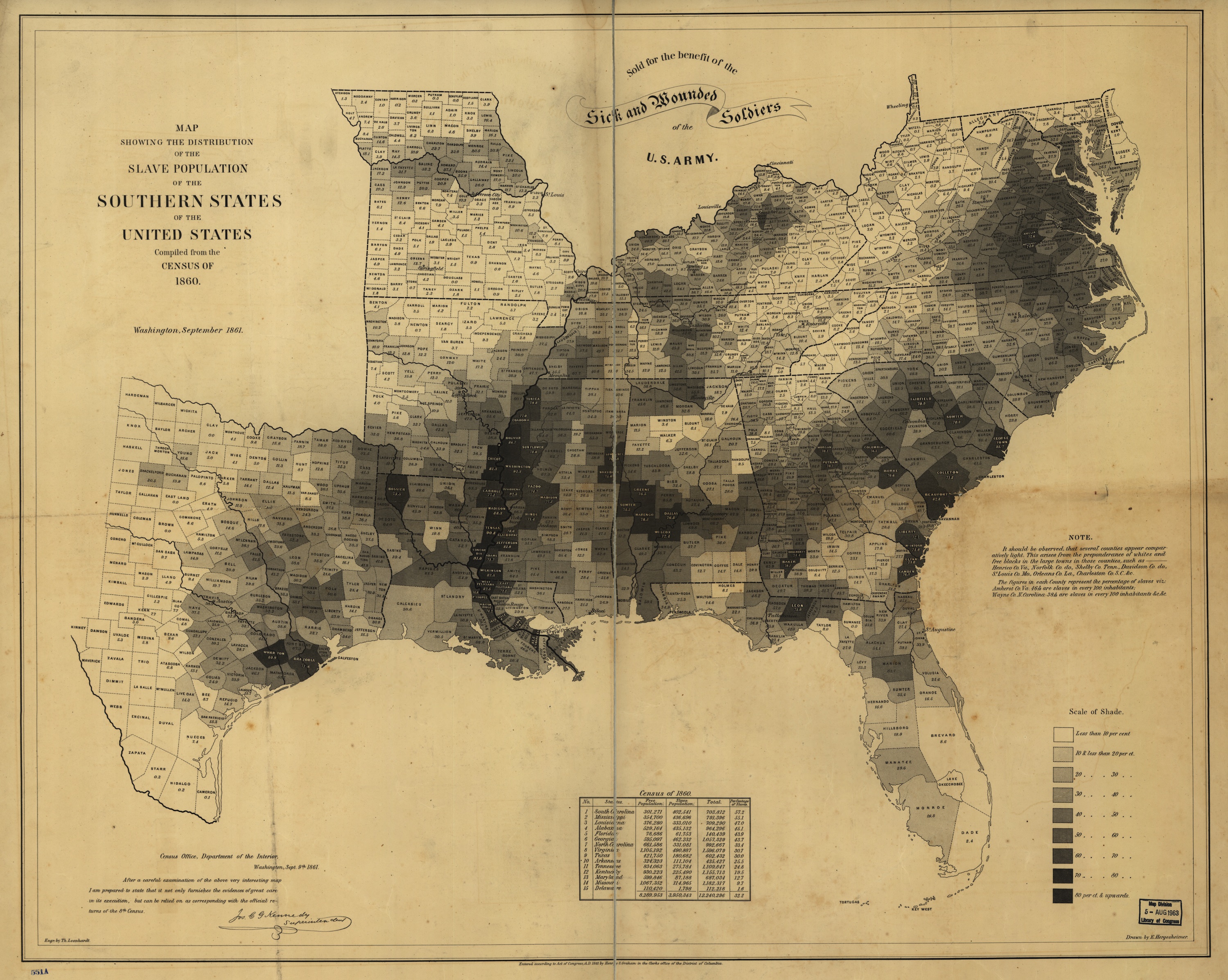
Arrows overlaid on the slavery map mark the general movements of Stoneman's Raid

     We've all seen those color-coded computer-generated maps that give us a county-by-county snapshot of voting results, educational achievement, tornado warnings, or other indicators. It's all based on GIS, which stands for Geographic Information Systems.
     More than a century before GIS was invented, Abraham Lincoln's cartographers explored the concept on this map, which illustrates the prevalence of slavery from Delaware to Texas. Lincoln often referred to the map, and the government sold copies as a fundraiser for sick and wounded soldiers. Francis Bicknell Carpenter even included the slavery map in his historic painting of Lincoln's cabinet (see below).
     The photo above is a closeup of the map, which was drawn by the U.S. Coast Survey in 1861 based on the 1860 census. The darkest counties are those with the highest percentage of slaves in the total population. To see the full map, click here.
     This map illustrates one of the reasons why Stoneman's Raid met relatively light resistance. He was never deep in plantation territory, and few of the Southerners in his path had reason to defend slaveryFor example, slaves were just 17 percent of the population in Knox County, Tenn., 2 percent in Watauga, N.C., 18 percent in Wythe, Va., 27 percent in Rowan, N.C., and 32 percent in Greenville, S.C. 
     Across the Confederacy, slaves represented 39 percent of the population (though they counted as only 24 percent under the "three-fifths compromise" that was so important in pre-war politics).
     By comparison, Sherman marched through parts of Georgia and South Carolina where the majority of the population were slaves. In Beaufort, S.C. (which included what is now Allendale and Jasper), it was 82.5 percent.
     When this map was drawn, West Virginia was still part of Virginia. It was admitted to the Union in 1863 as the 35th state.
     If you look closely, you may notice that many counties were not yet born in 1861, including Avery, Mitchell, Transylvania, Swain, Clay and Graham in the mountains of North Carolina; and Oconee, Cherokee, Greenwood, McCormick, and Saluda in western South Carolina.


The slavery map is visible in the lower right corner of Francis Bicknell Carpenter's 1864 painting, First Reading of the Emancipation Proclamation of President Lincoln. Stoneman's nemesis, Secretary of War Edwin Stanton, is at the far left. Treasury Secretary Salmon P. Chase is standing behind Lincoln. To the right, Interior Secretary Caleb Blood Smith and Postmaster General Montgomery Blair are standing, and Navy Secretary Gideon Wells, Secretary of State William Seward, and Attorney General Edwin Bates are seated. The painting hangs today in the U.S. Capitol, in the West staircase of the Senate wing.

Saturday, August 8, 2015

Scoop! One of Stoneman's newspapers

CREDIT: University of Georgia archives

 When I began researching Stoneman's Raid, I was fascinated to discover that the Union troops published newspapers in three towns they briefly occupied: Salisbury April 12, Spartanburg April 30, and Athens May 6, 1865.
 I contacted historians in all three towns but was unable to find any of these newspapers during the 150th-anniversary run of The Stoneman Gazette. That was disappointing but not surprising. Confederate publishers did not keep Yankee scrapbooks. In fact, they often erased history as they shaped the myth of the Lost Cause. For example, the publisher of the Salisbury newspaper squelched any mention of Stoneman's Raid in a 618-page history of Rowan County that he published 16 years after the war. (Stoneman's scribes did not ignore him, as we shall see!)
 So I was pleasantly surprised to hear recently from a diligent librarian at the University of Georgia who was able to track down this copy of the Athens paper (click here to enlarge the image). Even better, it includes stories from the other two editions.
 You may not be impressed, but this old newspaperman feels like he has found a buried treasure.
 Each story warrants its own discussion, which we will do in subsequent blogs. Follow the links below.
 The scanned copy is smudged and hard to read, but I think this is what it says:

Thursday, April 9, 2015

A pawn in Grant's checkmate of Lee

Gen. Davis Tillson was assigned to guard the mountain passes behind Stoneman in North Carolina in case the cavalry had to retreat. That contingency suggests that the Union expected much more of a fight than the Confederates actually put up. 
Reporting from Boone on Palm Sunday, April 9, 1865, Gen. Tillson relayed the following update to Gen. George Thomas back in Nashville:
General Stoneman was at or near Wilkesborough N.C., on the 30th, moving down the Yadkin River with the supposed intention of destroying the important railroad bridge over the Yadkin River. This is an entirely different route from that General Stoneman said he should take when I last saw him.
By April 9, it had been nearly two weeks since Thomas had heard from Stoneman. If Tillson was correct, it meant that Stoneman had abandoned his primary mission, which was to attack the railroads in Virginia. Thomas had instructed Stoneman to follow the New River, which runs northeast from Boone toward Christiansburg, Va. Stoneman had assured Thomas on March 23, "I hope to be well into Virginia by the 28th." Their original plan went nowhere near Wilkesboro. 
Gen. Tillson's report was troubling, but it was also flawed.  First, it was 10 days out of date, reflecting the painfully slow communications in the South in 1865. Second, Thomas knew better than to try to suppose Stoneman's intentions. 
It turns out that Gen. Stoneman's route through Wilkesboro was not insubordination but just a calculated detour that doubled as a feint. Once he got to Boone and saw how long winter lingers in the mountains, he realized that his 4,000 cavalry would go hungry if they depended on the New River valley for food and forage.
In fact, Stoneman had notified Gen. Thomas of his change in plans in his report March 28 from Boone: "I shall be compelled to alter slightly from the proposed route on account of the great scarcity of forage and subsistence for the men. ... We shall, with ordinary good luck, be out of the mountains to-morrow." He neglected to say that they would be on the wrong side of the mountains, in North Carolina rather than in Virginia.
Stoneman chose to proceed east down the Yadkin Valley, which was 2,000 feet lower than Boone and already turning green. Stoneman's turn to the north was delayed by flooding along the Yadkin, but he entered Virginia on April 3, and by April 9 he had carried out his orders and accomplished his missiondestroying the railroads to prevent any westward retreat by Robert E. Lee.

Gen. Stoneman's military mindset was similar to that articulated by his old West Point roomate, Confederate Gen. Stonewall Jackson: "Always mystify, mislead, and surprise the enemy if possible."
In fact, Stoneman was so determined to surprise the enemy that he sometimes confounded his own side as well.  
Stoneman's own troops knew better than to try to anticipate his plans. Here's what one Ohio soldier wrote in the Cleveland Daily Leader May 30, 1865:
General Stoneman's characteristic is reticence. His own trustiest officers know nothing of where or when he is to move, and are soon taught by his strategy—as incomprehensible to his command as his enemy—to forebear surmising.
A history of the 12th Ohio Cavalry written in 1871 by Capt. Frank H. Mason expresses similar frustrations, followed by revelation:
It would be interesting even at this late day, to know the precise object of that tortuous, zigzag course from Knoxville to Christiansburg. To make three hundred and fifty miles of actual progress the column had marched nearly twice that distance. [Actually, the direct route from Knoxville to Christiansburg would have been about 250 miles, and the cavalry's route was about 400.] If Stoneman's purpose was to deceive and confuse his enemy, he must have been remarkably successful, for his own men, even his Brigade commanders, were kept wholly in the dark. They went from point to point as they were directed from day to day, but no man in the column except its commander could even guess its destination.
At Christiansburg, while ripping up the track of the Virginia railroad, the whole scheme was suddenly revealed to us. We were cutting the last avenues of escape that lay open to Lee, and were a part of the machine by which the last great army of the Confederacy was to be hopelessly ensnared. Grant was at Petersburg playing his pieces in the final combination against Lee, and Stoneman was the hand with which he had reached out to move the pawns. From this moment, every soldier in Stoneman’s Division felt that the end was near. The collapse was approaching, and we, every man of us, would be in at the death.

As far as I can tell, Stoneman had no contact with his headquarters from the time he left Boone March 28 until April 13, when he reported the conquest of Salisbury. For two weeks, he was guided by his own instincts. One officer described the general's nightly routine, sitting alone with his maps, "swearing and planning."
Gen. Stoneman and aviation pioneer
Thaddeus Lowe ascended in this balloon
to scout troop movements near Richmond.

Like any commander, Stoneman craved military intelligence. Back in 1862, for example, Stoneman personally went up 500 feet in a hydrogen balloon to scout the prospects of an attack against Richmond. When crossing the Blue Ridge at Boone, he set up a series of mountaintop flag stations in hopes of communicating messages between North Carolina and Tennessee.
Given the scarcity of telegraph and railroad lines in the mountains and foothills he raided, it was almost impossible to stay in touch. That's why the telegraph shenanigans the night of April 4 in Christiansburg were so important.
When Stoneman's second-in-command, Gen. Alvan Gillem, filed his report on the raid, he alluded to the Wilkesboro detour as part of the deception that made the raid so successful:
I cannot close this report without remarking on the complete surprise of the rebels at every point at which we appeared. When the expedition crossed the Blue Ridge into North Carolina, they were convinced that Salisbury was the point of intended attack. By turning due north from Jonesville, the enemy were completely surprised and the Tennessee & Virginia Railroad at our mercy. When marching south in the direction of Danville and Greensborough by Martinsville, the enemy withdrew several thousand of their troops from Salisbury before they discovered the real point of attack.
The Confederates were not only surprised but played into Stoneman's hands when they concentrated their forces to defend their towns, even burning their own storehouses and bridges to keep them from falling into Yankee hands. Stoneman had no interest in holding territory, taking prisoners, or laying siege. He understood the tactical advantage of cutting railroad and telegraph lifelines, which the rebels often left undefended. 
By April 9, the date of Tillson's misinformed report, Stoneman was finished in Virginia and had returned to North Carolina, where he was about to spring attacks on Greensboro and Salisbury.
By the way, something else happened on Palm Sunday, April 9 (although the news wouldn't reach Stoneman until April 13) ...
Lee surrenders to Grant at Appomattox, April 9, 1865 (illustration by Alfred Waud)


'I suppose Generals know best'

The Moratock Iron Foundary under the Confederate flag
DANBURY, N.C.
     After a week in Virginia where his troops amputated more than a hundred miles of railroad tracks, Stoneman headed back into North Carolina on April 9, 1865. 
     North Carolina was not mentioned in his marching orders from Gen. George Thomas, but he could justify it as a prudent route back to Tennessee.
     If Stoneman had known that Robert E. Lee had surrendered that same day, or that Confederate president Jefferson Davis was headed for Greensboro, or that the Confederate prison in Salisbury had been evacuated, he might have gone a different direction. He knew that if he could free the prisoners or capture Davis, he would become a national hero.
     The Confederates at Greensboro knew that Davis was coming from Danville and feared that Stoneman would strike simultaneously from Virginia. Gen. Pierre Beauregard made the fateful decision to withdraw troops from Salisbury to defend Greensboro, which at the time was the smaller of the two towns.
     People in Salisbury were perplexed. "I don't know what they mean leaving Salisbury so unprotected, but I suppose Generals know best,'' a young lady named Mollie Cochran wrote to her cousin in the Confederate army. "General Beauregard was here yesterday, so I guess it was his orders."
     In the meantime, Stoneman destroyed one more piece of the Confederate war machine, the Moratock iron foundary near Danbury that had forged sabres and munitions. By this time, he had reunited over 90 percent of his forces, lacking only Major Wagner's battalion, who hadn't been heard from since they were dispatched April 4 toward Lynchburg.
     The next day at Germantown, Stoneman ordered his 1st Brigade to make tactical strikes against railroad trestles and factories around Greensboro to keep the rebels there on the defensive. Meanwhile, the 2nd and 3rd Brigades would head toward Salisbury via Mocksville


Ruins of the Moratock Iron Foundary in Danbury
NEXT➤ A pawn in Grant's checkmate of Lee

Saturday, April 4, 2015

How to hack Confederate secrets

President Lincoln and his youngest son Tad were hailed by freed slaves as they walked the streets of Richmond on April 4, 1865Tad's 12th birthday. Richmond had been abandoned just two days earlier by Gen. Robert E. Lee and Confederate President Jefferson Davis, and it was up to Gen. Stoneman's cavalry to make sure they didn't escape. (Illustration by Thomas Nast)

   CHRISTIANSBURG, Va.
     Stoneman's raiders rode into Christiansburg near midnight on April 4 and caught the town asleep.
     The one Confederate on duty was the telegraph operator, and before he could tap S-O-S, the Yankees had a pistol to his head.
     There are several versions of what happened next. According to a lengthy report on the raid written by one of Stoneman's men, Gen. George Stoneman himself personally took charge of the situation:
     Immediately proceeding to the telegraph office, which the operator, in his haste to save himself, had left in perfect order, the General took possession, and succeeded in “calling” the Lynchburg operator, who at first was a little suspicious and answered back, “How are you, Yanks?” The reply was made, “You must be drunk, there are no Yanks any where around here.”
     Lynchburg—“What has become of the Yankees you have been telegraphing about all day as approaching?”
     Christiansburg—“Oh that was nothing but country rumors, and were found to be false.”
     Lynchburg was soon satisfied, and then proceeded to give the Christiansburg operator a lecture for sending rumors over the line, as they generally turned out false, ending it by saying that “during the day is has been reported through town that Sheridan was coming this way, but no one believes it now.” He then sent several messages, military and civil, one of the military messages of considerable interest ot the General, as it informed him of the intended movements west of him. The line refused to work soon after, and it was judged that it had been cut, and, as all supposed, it afterward proved true, that Major Wagner had arrived near Salem, and was tearing up the road and burning bridges.
     A more likely scenario* is recorded in the journals of our unofficial war correspondent, Capt. Henry Weand of Norristown, Pa. Here's his account of what happened that night in Christiansburg: 
     There had been assigned to the brigade a young telegraph operator, John J. Wickham**, who, when opportunity offered, rendered valuable assistance. Before reaching Christiansburg we had learned that the office of the telegraph company was in a freight car at the farther end of town, and before the Regiment reached that place, Lieutenant Hinchman, with a small detachment with Wickham, was sent to capture it and learn what he could of the movements of the rebels from the dispatches he could gather in.
     Making their way round the town in the evening they reached the car without discovery, and captured the operator at his instrument. Wickham began calling “Lynchburg,” but recalling the fact that the operator there would know a stranger was telegraphing, forced the Christiansburg operator to send the messages. He asked if they had any news of the Yankees, and kept up the conversation for some time, until a pointed question by Wickham, about the rebel forces, aroused the suspicion of the Lynchburg man, who said, “I believe I’m talking to the Yankees now.”
     Wickham then took the key and told him truthfully who he was, and at that the Lynchburg man let out with all the “cuss” words he was able to recall, and even these could not express his feelings at having given any information that could give aid and comfort to the enemy.
     Especially was his blasphemy heaped upon the poor operator who had been forced to send the messages. But here Wickham stopped him, and wired back that he should not blame him, as a fellow with a pistol at his head is apt to say just what the fellow who holds the pistol wants him to say. That ended the telegraphing, but the operator at Christiansburg thanked Wickham for the message he sent, as it would put him right with his associates in the rebel service.
     The fact that Stoneman inserted himself into this episode (whether or not he was actually there in person) tells you how important this was. For 10 days after leaving Jonesborough, Tenn., he had been offline, so to speak. He still had no way to contact his headquarters back in Tennessee, but now he had gained priceless intelligence from the enemy.
     Neither of those accounts decodes what Stoneman learned from those telegrams. But historian Clint Johnson tells us in his book, Pursuit: The Chase, Capture, Persecution, and Surprising Release of Confederate President Jefferson Davis
The Federals, mindful that telegraph operators recognized each other's tapping signatures, forced the Christiansburg telegraph operator to contact his counterpart in Lynchburg to learn war news. The Lynchburg operator willingly volunteered the news that Lee had abandoned Petersburg and Richmond. The questions kept coming until the Lynchburg operator finally tapped out: "I'm talking to the Yankees, aren't I?"
     In fact, President Lincoln had made a surprise appearance in Richmond 150 years ago today, on Tuesday, April 4, 1865, walking the streets of the Confederate capital and sending a powerful message that the war was all but over. Robert E. Lee's retreat was common knowledge in Lynchburg but was breaking news in Christiansburg. (On April 5, one of Stoneman's men found a Lynchburg newspaper that confirmed Lee's retreat.) 
     Stoneman now knew that Lee was coming his way. Providentially, he already had dispatched 220 men toward Lynchburg (the Wagner battalion that he assumed had cut the lines at Salem). Lynchburg was just 20 miles from Appomattox, where Lee was headed. 
     Conversely, Lee also now knew that the Yankees had him surrounded. Stoneman's cavalry had headed him off at the pass. The mountain railroads that could have been his escape route were going up in smoke.  
       Stoneman's relatively small army would have been no match for Lee, but the beleaguered Confederate general didn't know that. Five days later at Appomattox, he surrendered the Army of Northern Virginia.
* ONE MORE PERSPECTIVE: The telegraph episode was also described by Captain Frank Holcomb Mason of the Twelfth Ohio Cavalry in an 1890 book called Sketches of War History. He wrote: "The telegraph office was captured, and a Union soldier, taking his seat at the operator's desk, exchanged military questions and confidences with the operator at Lynchburg for an hour or more before the trick was discovered." Capt. Mason was close to Stoneman and had high respect for him, so if the general had been personally involved in the telegrams, Mason certainly would have said so.

** JOHN JERVIS WICKHAM (1844-1898) was a native of Ireland who grew up in Beaver, Pa., and served three years as a telegraph specialist in the Union army. According to his obituary in the Pittsburgh Post-Gazette, "In June 1862, while serving as a cipher expert at the headquarters of the Twenty-third brigade, he was captured with the command by the rebel general, Forest, in action at Murfreesboro, Tenn. He was a prisoner of war for a number of months, his last place of confinement being Libby Prison." Confederate Gen. Nathan Bedford Forrest's cavalry defeated and captured Wickham's brigade to capture a Union supply post and hospital. After the war, Wickham became a lawyer and was a Pennsylvania Superior Court judge when he died at age 54.

NEXT➤ Some bridges you just hate to burn


Sgt. Angelo Wiser's map shows the April 4 march from Hillsville to Christiansburg via Jacksonville (now known as Floyd)

Monday, February 23, 2015

The high feud behind Lincoln's mountain map

Adolph Lindenkohl's topographical map illustrated the upper Tennessee Valley that was the planned route for Stoneman's Raid.
KNOXVILLE, Tenn.
 President Abraham Lincoln used this 1863 map to cast a vision for what became Stoneman's Raid. Pointing to East Tennessee, he told Gen. Otis Howard, "They are loyal there! They are loyal!"
Lincoln could see that the topography was as friendly as the population. The upper Tennessee Valley was a route ready-made for an invasion of Virginia, complete with a railroad. 
 This was almost certainly the same map that Gen. George Stoneman followed. The detail and precision are remarkable, and the renderings of watersheds and ridges were vital for routing his cavalry through the mountains. 
 To see the map full-size on the Library of Congress website, click here.
 The map was drawn by Adolph Lindenkohl (1833-1904), a native of Germany who became a U.S. citizen in 1857 and served as the Army's senior draftsman from 1862 to 1864. 
 Lindenkohl credits the detail about the mountains to the surveys done by Princeton professor Arnold Guyot in 1856, 1859, and 1860. This may be the earliest map that labels Mount Guyot, Mount Mitchell and Clingman's Dome, whose names were still unsettled at the dawn of the Civil War.
Dr. Elisha Mitchell (1793-1857) and Gen. Thomas Clingman (1812-1897)

 Dr. Elisha Mitchell and his former student, Gen. Thomas Clingman, had a bitter dispute about which of them had discovered North Carolina's highest mountain. The honor was eventually accorded to Dr. Mitchell after his tragic death on the mountain in 1857 and his burial on the summit in 1858.
 On this map, however, the peak we now know as Mount Mitchell is still labeled by its former name, Black Dome. This may reflect Prof. Guyot's reluctance to take sides in the Mitchell-Clingman debate. The point Lindenkohl labeled Mount Mitchell is now known as Clingman's Peak (not to be confused with Clingman's Dome in the Smokies, which is now known by its Cherokee name, Kuwohi). Black Dome is listed at 6,707 feet, as measured by Guyot. It's remarkable that 155 years ago he missed the official elevation of 6,684 by just 23 feet. 

Yadkin County N.C., near Gen. Clingman's home

In 1861, Clingman was one of the state's leading advocates for secession. He became a Confederate general who was wounded at Cold Harbor and nearly killed at Globe Station, Va. He was recuperating at Shallow Ford Plantation near Huntsville, N.C., when part of Stoneman's 1st Brigade crossed the Yadkin River nearby, April 10-11, 1865.
The Yankees were busy preparing to attack Salisbury, or otherwise they might have captured Gen. Clingman. They did raid some of the houses around Huntsville and burned a local store. But they spared the houses, including some that stand today. Two Union troopers were shot April 10 as they tried to raid the home of a man named Greenberry Harding, and one of them, Dennis Shea, died April 22 in nearby Salem.
 Many of the town names have been changed since this map was drawn. For example, Taylorsville, Tenn., is now Mountain City, and Taylorsville, Va., is now Stuart, named after Gen. J.E.B. Stuart, who was Stoneman's counterpart in the Confederate cavalry. Both of those towns, as well as Taylorsville, N.C., were in the paths of Stoneman's troops.
 In Virginia, Cranberry Plain is now Hillsville, Jacksonville is Floyd, and Greensville is Galax. In Tennessee, Carter's Depot is now Watauga (near Johnson City). In South Carolina, Limestone Springs is now Gaffney, Pleasant Grove is Greer, Pickensville is Easley and Pickens has been relocated.