
 |
| The last skirmish of the Civil War east of the Mississippi was fought on the same ridge where textile baron Charles Lanneau built his estate in the 1870s. The neighborhood is now known as Alta Vista. |
Six weeks after the surrender of Gen. Robert E. Lee, the guardians of Greenville nearly retriggered the Civil War.
Greenville had been looted May 2, 1865, by some of Gen. George Stoneman's rear guard and was determined to defend itself against a band of Yankee outlaws who were reportedly coming up the road from Anderson.
It was May 22 or 23, 1865, depending on whether you trust the Union or Confederate account. By this time, many of Greenville's rebel soldiers were back home from the war. Sheriff William Shumate was able to assemble a formidable home guard that included at least five Confederate officers, four Citadel cadets, and a Who's Who of 19th-century Greenville.
Greenville had been looted May 2, 1865, by some of Gen. George Stoneman's rear guard and was determined to defend itself against a band of Yankee outlaws who were reportedly coming up the road from Anderson.
It was May 22 or 23, 1865, depending on whether you trust the Union or Confederate account. By this time, many of Greenville's rebel soldiers were back home from the war. Sheriff William Shumate was able to assemble a formidable home guard that included at least five Confederate officers, four Citadel cadets, and a Who's Who of 19th-century Greenville.
In the decades to come, many of these men and their families would shape Greenville into the "Textile Capital of the World" and would help lay the foundation for the New South. City streets were named for many of them: Capers, Elford, Earle, Jones, and Perry. Their battleground would become one of Greenville's most prestigious neighborhoods.
Yet their bravado almost led to a bloodbath. They thought they were facing a small band of marauders, but they were actually provoking a fight with a battle-hardened regiment of U.S. Cavalry—close to 500 Tennessee Yankees headed home from Stoneman's Raid.
After an exchange of gunfire, the Yankees captured three Greenvillians and made plans to execute them the next morning. Union troops also considered burning the town, Sherman style, as a deterrent to rebels. You have to wonder how Greenville might have been crippled and history might have turned out differently—if not for a fortunate encounter of Freemasons, noble forefathers of the Shriners.
In the twenty years I lived in Greenville, I never knew that it was the site of the last Civil War skirmish east of the Mississippi. Evidently, neither did the historians. It was not mentioned in county histories written by S.S. Crittenden in 1903, James M. Richardson in 1930, and A.V. Huff in 1995.
Then in 2002, Greenville attorney John B. McLeod published the following essay in the journal of the South Carolina Historical Society. McLeod (1950-2007) unearthed eyewitness accounts from Confederate Gen. Ellison Capers (1837-1908) as well as Union soldiers in the Thirteenth Tennessee Volunteer Cavalry.
McLeod does not mention it, but the 11th Michigan Cavalry also went through Greenville on April 23, according to an 1871 book by Charles Lanman. If that's correct, there were nearly a thousand Yankees in Greenville, and the soldiers involved were some of the worst disciplined in Stoneman's Raid.
Yet their bravado almost led to a bloodbath. They thought they were facing a small band of marauders, but they were actually provoking a fight with a battle-hardened regiment of U.S. Cavalry—close to 500 Tennessee Yankees headed home from Stoneman's Raid.
After an exchange of gunfire, the Yankees captured three Greenvillians and made plans to execute them the next morning. Union troops also considered burning the town, Sherman style, as a deterrent to rebels. You have to wonder how Greenville might have been crippled and history might have turned out differently—if not for a fortunate encounter of Freemasons, noble forefathers of the Shriners.
In the twenty years I lived in Greenville, I never knew that it was the site of the last Civil War skirmish east of the Mississippi. Evidently, neither did the historians. It was not mentioned in county histories written by S.S. Crittenden in 1903, James M. Richardson in 1930, and A.V. Huff in 1995.
Then in 2002, Greenville attorney John B. McLeod published the following essay in the journal of the South Carolina Historical Society. McLeod (1950-2007) unearthed eyewitness accounts from Confederate Gen. Ellison Capers (1837-1908) as well as Union soldiers in the Thirteenth Tennessee Volunteer Cavalry.
NOTE: In October 2016, more than a year after publishing this story, I discovered another gripping version of this incident written by the Union captain who was responsible for carrying out the executions. Some of his details differ from McLeod's. Click on the link to see more.The following material includes McLeod's account of the skirmish, his profiles of those involved, and a corresponding passage I found in the Tennessee regiment's history, published in 1903. [Brackets indicate additional material that I've interjected. On the one-day discrepancy of dates, I am inclined to favor the Union account because it fits into the timeline of the regiment's march. If that's correct, the skirmish was at dusk Monday, May 22, 1865, and the threatened executions would have been Tuesday morning, May 23. It is curious, however, that the 23rd is not mentioned in the Tennessee account.]
McLeod does not mention it, but the 11th Michigan Cavalry also went through Greenville on April 23, according to an 1871 book by Charles Lanman. If that's correct, there were nearly a thousand Yankees in Greenville, and the soldiers involved were some of the worst disciplined in Stoneman's Raid.
Last Clash of the War Between the States In South Carolina By John B. McLeod
It has long been thought that the last hostile encounter between Confederates and Federals in South Carolina occurred on May 1, 1865, outside of Williamston, in which a group of Arsenal Cadets exchanged fire with some Federal cavalrymen in pursuit of President Jefferson Davis of the Confederacy. Of course, the visit of Stoneman’s Raiders to Greenville on May 2, 1865, has been well documented, particularly in the letters of Caroline Gilman.
It now appears that a brief but violent skirmish between a group of Greenville home guards and a regiment of Tennessee Unionist cavalrymen took place on present day Crescent Avenue on May 23, 1865; this engagement produced no casualties, but almost resulted in the summary execution of three former Confederates and the sacking of Greenville. Although the Union cavalrymen were justifiably upset about being fired upon, they did not wreak havoc on Greenville but simply went on their way back to East Tennessee. This passage of arms is the last documented action of the War Between the States in South Carolina and, with the exception of a few skirmishes in Missouri and in the Indian Territories, was the last such engagement of the entire War.
After General Lee surrendered the Army of Northern Virginia on April 9, 1865, and General Joe Johnston surrendered the Army of Tennessee on April 26, 1865, a number of former Confederates had gradually returned to Greenville, usually on foot. The Federal garrison had not yet been established in Greenville, although General Van Wyck had been in this area for some time. During the War Between the States, Greenville had been plagued by a number of deserters and draft evaders, commonly called “outliers”, who took refuge in the foothills of the mountains, such as the “Dark Corner” area around Gowensville. During the War, the Greenville District Sheriff had been assisted by men organized into a “patrol” who attempted to keep the peace.
On May 2, 1865, a group of Union cavalrymen from Stoneman’s Cavalry Division paid a visit to Greenville and took almost everything that could be moved. There was little money available since Confederate currency was worthless and, in any event, there was very little to be bought although a few enterprising Confederates did try to set up stores. The Greenville and Columbia Railroad was not in operation at this time so Greenville was practically isolated from the outside world.
The month of May 1865 was probably very hot, and life in Greenville was at a fairly low ebb due to the disconsolation caused by the defeat of the Confederacy. The former Confederates, arriving home after four years of prolonged conflict, were trying to adjust themselves to normal life. Unfortunately, the War was not quite over.
On May [22 or] 23, 1865, word reached Greenville that a band of “outliers” was approaching from Anderson District. Sheriff Shumate sent out a call to the former Confederates to form a “home guard” to deal with this threat. A group of distinguished veterans of the late conflict answered the call, including Colonel E.P. Jones, Colonel C.J. Elford, Colonel B.B. Smith, Colonel James McCullough, Captain Leonard Williams, and even an Englishman who had fought for the Confederacy named Henry Wemyss Feilden. Governor Benjamin F. Perry’s son, Hayne, and the Earle brothers also responded to the summons.
This group quickly assembled and went with Sheriff Shumate to the “high ridge” south of the Reedy River which was known as Crescent Ridge (now Alta Vista and Crescent Avenue). Marching in hot weather being rather thirsty work, the men refreshed themselves at the mineral springs on Crescent Ridge. Armed with revolvers, muskets, and a few hunting pieces, the group headed east on the ridge in the direction of Mr. Lanneau’s house (on present-day Belmont Avenue) where they heard the sound of hoofbeats approaching. The group dispersed and took cover in the woods on either side of the track heading toward the Lanneau house. [Charles Lanneau's mansion (pictured above) at 417 Belmont Avenue was not built until the 1870s, but McLeod may be referencing a previous house or the general location.]
When the first horseman appeared, one of the group opened fire and several volleys ensued. This proved to be a tactical blunder, since the approaching horsemen were not “outliers” but rather were troopers of the Thirteenth Tennessee Volunteer Cavalry, USA, on their way back from Georgia after attempting to capture the elusive Jeff Davis. The cavalrymen, armed with Spencer repeating rifles, returned fire. The home guard, rather nonplussed by this turn of events, chose the better part of valor and took to their heels. Unfortunately, Colonel Jones and two others were rather slow and were bagged by the Union cavalry.
Things did not look good for the former Confederates. The Thirteenth Tennessee Cavalry was the same unit that had pillaged Anderson during the first of May while chasing Jeff Davis. In fact, the behavior of this regiment had been so bad that their division commander noted that “they are now so entirely destitute of discipline that it cannot be restored in the field and while the command is living on the country.”
The Federals conferred and decided that summary execution was an appropriate punishment for the captured home guards. The Federals did not even go through the motions of a “drum head” court-martial but decided that the sentence was to be carried out the next morning.
The Masons' "Grand-Hailing Sign of Distress."
Yes, it looks like a hold-up or a touchdown.

As time drew nigh for the executions, Colonel Jones (a Freemason) gave his order’s sign of distress to a Federal officer. This officer, also a Mason, postponed the execution and took the men before the brigade’s commander [Col. John Miller], another Mason, who interrogated Colonel Jones and the others closely and was satisfied with their response that they were not “bushwhackers” and had not fired any shots. Colonel Jones and the others were released, and the troopers headed into Greenville.
[The Masons were forerunners of the Shriners, who organized the Hejaz Temple in Greenville in 1919 and opened a children's hospital there in 1927. At least one of the veterans of the 1865 skirmish, Baylis Earle, lived to see that day.]
The citizens of Greenville, obviously fearful of a repetition of the events of May 2, awaited the arrival of the Federal troops with dread. Fortunately for all concerned, the Tennesseans were anxious to return to East Tennessee and were well-behaved. Apparently, there had been some discussion among the cavalrymen about putting Greenville to the torch because of the rude behavior of its home guard. According to a contemporary Union history, it was a near thing:
The men of Stoneman’s division were chagrined by their failure to reap the rewards of the capture of Mr. Davis, particularly after being in close pursuit for over a week. After resting in Georgia for a short period, the three brigades were ordered back to Tennessee.
The return was not without incident. Miller’s brigade, while passing near Greenville, South Carolina, was attacked by a band of guerrillas, driving them off in a hail of musketry, capturing two or three. The war being over, mercy was shown and the rebels were spared, as was the village.
The ladies of Greenville prepared a meal for the men from what resources they had available and their horses were provided with forage. After spending the night in Greenville, the Thirteenth Tennessee headed toward Hendersonville and through Asheville, to East Tennessee.
Life in Greenville returned to normal and its citizens awaited the arrival of Federal troops, not as raiders, but as occupiers. Unlike some other communities, Greenville did not suffer greatly during Reconstruction and, in fact, enjoyed a measure of prosperity.
 |
| Union Lt. T.C. White was ordered to execute three Greenvillians |
'Shoot them without trial or ceremony'
Here's the Union account of the Greenville incident, according to the History of the Thirteenth Tennessee Volunteer Cavalry, written by Capt. Samuel Scott and Adjutant Samuel Angel and published in 1903.We left Greensboro, Ga., on the 20th on our return to East Tennessee. The war now being ended, the great anxiety of officers and men to return to Knoxville where it was believed we would soon be mustered out of the service was an incentive to hard marching and kept up the spirits of the men. We crossed the Savannah River on the 21st on some of the same pontoon bridges that had been used by Gen. Sherman's troops on their march South. On the 22nd we passed through Williamston and camped three miles south of Greenville, South Carolina. [The campsite would have been in the vicinity of where the Shriner's Hospital for Children now stands. It would have been normal procedure for some of the cavalry to scout the perimeter, which would have brought them to Crescent Ridge.] Just before reaching that place we were fired on from ambush by some guerrillas or "bushwhackers" and captured the men who were supposed to have been involved in the firing.
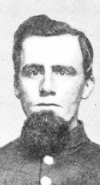
The next morning, it was decided to shoot them without trial or ceremony, as it was felt that now that the war was over, examples must be made of men engaged in outlawry. Lieut. T.C. White was ordered to take a squad of soldiers and after the command passed, shoot these men, bury them, and rejoin the command. After the main body of the command had passed and the rear guard came up under Lieut. [James] Freels and Lieut. White was ready to execute his orders, the older of the three prisoners asked if there was a Freemason present. Dr. Cameron, who was a member of that order, was pointed out and the prisoner gave him the "Grand-hailing sign of Distress" of the order, whereupon Dr. Cameron agreed to take the responsibility of requesting Lieut. White to postpone the execution and bring the prisoners forward until Colonel Miller, who was also a Mason, could be consulted. After questioning the men closely and hearing a very straightforward story from them that they were disbanded Confederate soldiers returning to their homes, that they had had no arms since leaving the army and were not engaged in firing on the command, Col. Miller released them.
Dr. James Cameron
intervened to save
a fellow Mason
On the 24th, the command reached Greenville, S.C., where they got a full supply of rations and remained overnight. On the 25th we again crossed the Blue Ridge at Saluda Gap, passed through Hendersonville, N.C., and camped within four miles of Asheville, N.C.
Who's Who in Greenville history
Neither account identifies the other two captives who were almost executed along with Col. Jones. Given that the Tennessee account describes Col. Jones as "the older of the three men," it is possible the other two were the Earle brothers, since they were considerably younger than the other Greenville defenders. Whoever they were, they were likely among the men that McLeod included in this "Cast of Characters":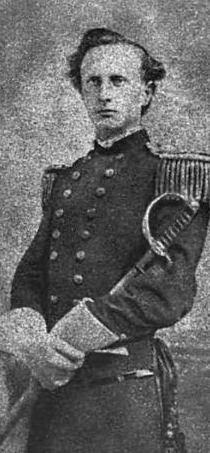 |
| Gen. Capers later became an Episcopal bishop |
Bishop Ellison Capers [1837-1908]: Bishop Capers was born in Charleston on October 14, 1837. After graduating from The Citadel in 1857, he served as a professor and instructor at that institution until the outbreak of the War. He and Clement H. Stevens formed the Twenty-Fourth South Carolina Volunteer Infantry Regiment in April of 1862, and Capers served as its Lieutenant Colonel through a number of battles and was promoted to Colonel of the Regiment in 1864. He was wounded at the Battle of Franklin and promoted to Brigadier-General in command of Gist’s Brigade on March 1, 1865. He served for a brief period of time as Secretary of State for South Carolina until he was ordained into the ministry of the Protestant Episcopal Church. For twenty years he was rector at Christ Church Episcopal in Greenville and was elected Bishop in 1893. Bishop Capers accepted the honor of Chancellor of the University of the South but died four years later in 1908 at the age of seventy-one. He was buried at Trinity Churchyard with the inscription on his tombstone being: “He rendered unto Caesar the things that were Caesar’s and unto God the things that are God’s.”
The Earle brothers: Bishop Capers mentioned that the home guards included the “Earle Brothers,” which probably referred to Baylis J. Earle (1843-1928) and Elias Drayton Earle (1841-1894). Both young men had enlisted in the Sixth South Carolina Cavalry Regiment while students at The Citadel.
Charles J. Elford [1821-1867]: Elford had been editor of a newspaper (in conjunction with Benjamin F. Perry) that opposed secession. Nevertheless, in the fall of 1861, he raised ten companies to form the Sixteenth South Carolina Volunteer Infantry Regiment and was elected Colonel of that regiment. In April of 1862, Colonel Elford was not re-elected and returned home to command the Third South Carolina Reserve Regiment. [Elford was Greenville's mayor in 1860-61, published The Confederate Sunday School Hymn Book in 1863, and was part of a delegation that went to the White House after the war to assure President Johnson that South Carolina would cooperate in rebuilding the nation.]
Love drew Henry Feilden
to Greenville

Henry Wemyss Feilden [1838-1921]: Henry W. Feilden was born in Lancashire, England, in 1838, and served as an officer in the Black Watch Regiment until he resigned his commission to fight for the Confederacy. He served on General Beauregard’s staff in Charleston and later served under General Hardee in the Carolinas Campaign. During the latter stages of the War, he was courting Julie McCord who was a refugee with her family in Greenville. It appears that Captain Feilden spent some time in Greenville during the summers of 1864 and 1865. He married Julie McCord in 1865 and returned to England where he re-joined the army, serving in the 18th Hussars and retiring as a colonel about 1890. In 1875-76, he served as a naturalist on the British Polar Expedition. He came out of retirement in order to serve in South Africa during the Boer War and then retired, this time to Burwash, Sussex, where he became a close friend of Rudyard Kipling.
E.P. Jones: Jones was a lawyer from Greenville who joined the Second South Carolina Infantry Regiment as a private and was promoted to colonel in February of 1862, only to fail to be re-elected in May of the same year. He apparently returned to Greenville and had a successful career as an attorney and promoter of Greenville. He was described as “a gentlemanly practitioner of law where he has made his mark, and from his military reputation, firm, polite, but stern in the execution of his duties . . . decidedly popular.” [Other sources mention an Erwin (or Ervin) P. Jones who was promoted from private to lieutenant colonel on May 16, 1861 and was still serving in that position in February 1863. Let me know if you have more background on Jones. I believe he was a Richmond agent for Greenville's Markley Carriage Factory in 1864 and may have been treasurer for the upper districts of S.C. under Gov. John L. Manning in 1854. Jones and Crittenden were among the directors of the Greenville and Laurens Railroad when it was founded in 1878.]
James L. McCullough [1824-1892]: A planter in the southern part of Greenville District prior to the war and a slave owner, James McCullough succeeded Colonel Elford as Colonel of the Sixteenth South Carolina Infantry. He remained in command until February of 1865 when the regiment was consolidated with other South Carolina regiments. [McCullough's home in the Princeton community south of Ware Place is the oldest brick house in Greenville County. It is being restored by the Fork Shoals Historical Society.]
Congressman William Hayne Perry

William Hayne Perry [1839-1902]: Lieutenant Perry was the son of Benjamin Franklin Perry and Elizabeth Hext McCall Perry. His father was a prominent attorney and unionist in Greenville and served as Provisional Governor of South Carolina in 1865. At the outbreak of the War, he joined the Brooks Troop (raised in Greenville) and served in the Second South Carolina Cavalry through the War. After the War, Hayne Perry was very active in civic affairs in Greenville, including the newspaper and textile businesses. Lieutenant Perry was a member of the South Carolina House of Representatives, a state senator, and solicitor for four years. After serving three terms in the U. S. Congress, he returned to Greenville and resumed the practice of law, dying at “Sans Soucie” on July 7, 1902. He was buried along with his parents at Christ Church Cemetery in Greenville.
William T. Shumate [1827-1916]: Born in Greenville District on November 28, 1827, Shumate entered the service of the Butler Guards as a private in 1861 and served in the Second South Carolina Infantry until he was wounded at Chickamauga. He was elected Sheriff of Greenville District in 1864 and served until 1868 when he refused re-election. [Shumate's obituary says he was the very first soldier mustered into the Confederate Army.]
B. Burgh Smith [1835-1904]: Born in Charleston in 1835, Colonel Smith graduated from The Citadel in 1855. An engineer and physician, he served in various posts in and around Charleston until he was sent to Vicksburg and later wounded at Franklin. After recovering from his wounds, Colonel Smith was assigned as the Commander of the Sixteenth South Carolina Infantry Regiment. He was then Colonel of the Sixteenth and the Twenty-Fourth South Carolina Regiments after their consolidation in North Carolina prior to surrender.
Leonard Williams [1823-1908]: Born in Newberry District in 1823, Leonard Williams moved to Greenville in 1855 and became a merchant and planter. Along with many others, he joined the Brooks Troop which became part of the Second South Carolina Cavalry. Having participated in a number of battles, including Gettysburg, Captain Williams was commended by General J. E. B. Stuart for his “efficiency and conspicuous bravery.” Capt. Williams served in the South Carolina Legislature and played an important part in Wade Hampton’s campaign [for governor] in 1876. [David Douglas wrote a book, "A Boot Full of Memories," based on 130 letters Williams wrote during the war, most of them to his wife Anna Laval Williams in Greenville.]
Thirteenth Regiment Tennessee Volunteer Cavalry, USA: This Regiment consisted of a number of men from Carter and Johnson Counties in East Tennessee who had strong Unionist sentiment, as well as some Tories from North Carolina; in fact, a number of these men had been involved in bridge burning against the Confederate government and some were deserters who had served in the Confederate Army. The Regiment was mustered into Federal service in October of 1863 and served in and around Knoxville until it was sent on Stoneman’s first raid into Virginia in December of 1864. On November 11, 1864, the Thirteenth Tennessee was defeated by Confederate forces under General John C. Breckinridge and all of its wagons were captured. After returning from Stoneman’s first raid into Virginia, the Regiment camped around Knoxville until it was once again called into service under General Stoneman in his raid into Virginia and North Carolina. The Thirteenth Tennessee left East Tennessee in late March 1865 and spent the next month rampaging around Virginia and western North Carolina. The Regiment participated in the Battle of Grant’s Ford, which resulted in the capture of Salisbury, North Carolina, and then was heading back to its home in east Tennessee when it was ordered (as part of Miller’s Third Brigade of Stoneman’s Cavalry Division) to the pursuit of Jefferson Davis. The Thirteenth Tennessee participated in the pillaging of Anderson and then moved on into Georgia where it narrowly missed capturing Mr. Davis. At the time it was mustered out in the summer of 1865, the Thirteenth Tennessee numbered more than 500 officers and men.


