Thursday, April 14, 2016

First in war, last in peace, and still sipping taxes

By the epic standards of the Civil War, Stoneman's Raid was relatively trivial. 
Yet it is rich in material for a game of Trivial Pursuit in a category we'll call Civil War Bookends.
The answers to all these first-and-last questions can be found in the annals of Stoneman's Raid.

 Who was the first man mustered into the Confederate army?
 According to an obituary I found from The Greenville News dated June 27, 1917, it was William T. Shumate of Greenville, S.C.: "Mr. Shumate, according to the story he and his friends often related, was a member of the old Butler Guards, an ante-bellum military organization in Greenville. The guards volunteered for service in 1861 upon the outbreak of the war, and upon proceeding to Virginia, were mustered in. Mr. Shumate was the tallest man in the command, so was placed on the extreme right. The mustering officer took the men from right to left, and this company happening to be the first selected, Mr. Shumate was the first man to be mustered into the service."
 The Butler Guards, later known as Company B of the Second South Carolina Infantry, organized January 5, 1861—just two weeks after South Carolina voted to secede. They were called to active duty on April 15, three days after the bombardment of Fort Sumter, and were among several companies mustered in on May 22 and 23, 1861 in Richmond, Va. (We'll reveal Shumate's role in Stoneman's Raid at the end of this quiz.)

 So who was the first to enlist for the Union?
I don't know for sure, but a tall Ohio schoolteacher named Erastus Cratty Moderwell was among the very first who enlisted April 14, 1861, under a Kentucky abolitionist named Cassius Clay. A tribute to Moderwell in a 1912 memorial book said this was the "first volunteer organization raised for the War of the Rebellion."
Moderwell became a major in the 12th Ohio Cavalry, which was one of eight regiments in Stoneman's Raid. On April 21, 1865, he impersonated the 6-foot-4 Stoneman, fooled the Confederates, and bluffed them into surrendering the Nation Ford railroad trestle across the Catawba River, cutting the lifeline between Charlotte and South Carolina. Historian Benson John Lossing described this raid as "one of the most gallant little exploits of the war."
If only wars were always this much fun!


 Who loaded the first gun fired at Fort Sumter? 
 Historians may not agree with me on this, but I still like the story told by a Georgia soldier named Thomas Wheat who was captured by Stoneman's troops April 10, 1865, in Winston-Salem, North Carolina. "I had nothing against the Yankees," he told a New York newspaper, "but I was in for anything that promised a little sport."
 The first shot from Fort Sumter, by the way, was fired by none other than Abner Doubleday of baseball fame. The closest I can tie him to the raid is that he graduated from West Point just before Stoneman matriculated.
Two old South Carolina newspapers say that a Citadel cadet named Paul Allen (or Allan) was responsible for the first and last shots of the war

Where was the last Confederate victory?
Some say it was the defense of the Yadkin River bridge by Col. Zebulon York on April 12, 1865, during Stoneman's invasion of Salisbury, N.C. My vote is for Swannanoa Gap, where short-handed rebels and their one-armed general prevented Stoneman's Raid from crossing the Blue Ridge on April 20 and won a temporary reprieve for the citizens of Asheville. Both of those rebel stands came after Robert E. Lee's surrender on April 9.

Who was the last Confederate veteran in North Carolina?
A former slave named Alfred "Uncle Teen" Blackburn received the state's last Confederate pension ($26.26 per month) until 1951, when he died at age 109. Blackburn served in the rebel army alongside his master, so you could say that he owed his freedom to a war he lost. Uncle Teen was an eyewitness to one of Stoneman's battalions that burned three mills in Yadkin County on April 1, 1865.


What about the last Union pension from the Civil War?
There's one remaining. Irene Triplett of North Wilkesboro, N.C., still gets $73.13 per month from Uncle Sam for her father's service with Kirk's Raiders, a Union outfit under Stoneman's command who occupied Boone, N.C., in April 1865. She turned 86 in January 2016. Her father Mose Triplett was 83 when she was born in 1930 and 92 when he died in 1938, just a few days after attending the 75th anniversary of the Battle of Gettysburg. In effect, your taxes are still paying for Stoneman's Raid.

Who were the last Confederate soldiers killed in battle with Union troops?
As far as I have found, the last two were A.C. Wall of Texas, shot on or about May 9, 1865, near Madison, Ga., by Stoneman's 12th Ohio cavalry; and McKenzie "Theodore" Parker of South Carolina, killed May 3 in Anderson, S.C., by Stoneman's rear guard. The last Confederate officer killed in action was probably Captain Charles Connor of Catawba County, N.C., who was shot April 17, by Stoneman's 10th Michigan cavalry as they rode through Newton, N.C. There were several Yankees killed later, including two by friendly fire in the capture of Jefferson Davis on May 10.


Who was the last veteran of Stoneman's Raid? 
William Magee of the 12th Ohio was one of the last three Union soldiers alive before he died January 23, 1953, at age 106. Magee was an 18-year-old bugler in the regimental band that serenaded the young ladies of Athens, Georgia, on May 4, 1865. The last combat veteran of the Civil War, a New York infantryman named James Hard, outlived Magee by 48 days.

Who was the last Medal of Honor winner of the Civil War?
Col. Charles Betts of the Fifteenth Pennsylvania received the award in 1892 for leading 75 men from Stoneman's Raid who captured the Third South Carolina Cavalry April 11, 1865, near Greensboro, N.C. Robert E. Lee had surrendered in Virginia two days earlier, but neither side had heard the news.


Where was the last Confederate skirmish east of the Mississippi?
Let's end where we began, with the long arm of the law—tall Bill Shumate in Greenville, S.C. Sheriff Shumate organized a small force of Confederate veterans who exchanged gunshots with the Union's Thirteenth Tennessee Volunteer Cavalry. The skirmish was May 22, 23, or 24, 1865 a
s the Yankees headed home from Georgia following Stoneman's Raid. There is no mention of the skirmish in Shumate's obituary nor in three books on the history of Greenville County, and there is no historical marker on the likely site near Crescent Avenue. In recent years, however, Union and Confederate accounts have been found that show that the Yankees were on the verge of executing three or four captured Greenvillians and burning down the town—until the Masons intervened.
William T. Shumate

Sunday, January 24, 2016

Revisiting the Lincoln-Calhoun debate

Judge Felix Alley's 1941 book tried to show the underlying resemblance between Lincoln and Calhoun.
CRAYTONVILLE, S.C.
 The last time The Stoneman Gazette delved into Abraham Lincoln's parentage, the Yankees were in Lincoln County, N.C., where it was widely rumored that that the president had been born in the hills nearby.
 Now that DNA tests have traced the lineage of Lincoln's mother, let's explore another possible root of Lincoln's family tree. This one involves John C. Calhoun, the South Carolina statesman who was known as the "Father of Secession."
 Could Calhoun have also been the father of the president who defeated secession?
 Indeed, it appears likely that Calhoun had a fling with a young lady named Nancy Hanks. She lived in Anderson County, S.C., and her ancestors and mine share the same graveyard.
 After further review, however, I would say it is unlikely that she was the same Nancy Hanks who married Thomas Lincoln and gave birth to Abe, not necessarily in that order.
 Unlikely—but not impossible.
Lloyd Ostendorf's 1963 portrait
 of the enigmatic Nancy Hanks Lincoln
 Nancy Hanks was not an uncommon name. After Lincoln disclosed his mother's name in his 1860 campaign biography, more than a dozen Nancy Hanks were mentioned as the possible mother of the president. Hanks families here and there were suddenly reminded of young Nancies who had moved west over a half-century earlier. "Do you think Lincoln's mother could have been OUR long-lost Nancy?" You can see how rumors got started.
 Similarly, Calhoun is just one of a dozen men who have been investigated as Lincoln's possible father. You can read about them in The Many-Sired Lincoln, a 1925 story in The American Mercury magazine by a University of North Carolina professor named J.G. de Roulhac Hamilton.
 Regarding Calhoun, Hamilton reported:
     At Craytonville, Anderson County, South Carolina, was a stage-road tavern kept by one Christopher Orr. In Orr’s employ was a girl from the neighborhood, named Nancy Hanks, who was possessed of unusual beauty. At Abbeville lived Calhoun, a young, unmarried lawyer who made frequent trips to Pendleton by way of Craytonville. When he reached Orr’s tavern he nearly always developed a sick headache of such severity as to compel his stopping. Presently it was discovered that Nancy, free of favors, of course, was the cause of his visits and that presumably he was responsible for the condition which led to her discharge, and to her rejection by her own people. Calhoun then bought a horse and saddle and sent her off with some horse-drovers to Kentucky, where she had an uncle. Two months later her child was born and named for her uncle, Abraham Hanks. Six months later, the ever-obliging Thomas Lincoln married her. A variant of this is that Thomas Lincoln came to South Carolina with the horse-traders and for a consideration agreed to take Nancy off Calhoun’s hands. A frill on the story is that Calhoun once left Washington on horseback, bound for Kentucky, ostensibly to visit Henry Clay, but really to see his son Abraham. The rumor does not indicate whether he admired him or not.
       There was undoubtedly a Nancy Hanks at Craytonville, but she never married Thomas Lincoln nor gave birth to Abraham Lincoln. She did marry and was living long after the death of Nancy Hanks Lincoln [in 1818]. Whether or not the story of her relations with Calhoun is true is a matter of no importance so far as Abraham Lincoln is concerned.
 The Calhoun-Hanks relationship is no secret to historians. Margaret Coit detailed it in her 1950 Pulitzer Prize-winning biography, John C. Calhoun, American Portrait. (Flip to pages 49-52.) She wrote that Hanks "may even have been related to the Kentucky girl who became the mother of Abraham Lincoln."
 Coit does not mention a pregnancy but says that Calhoun had lifelong regrets about the relationship, even suggesting that it may have haunted him in his own presidential aspirations.
 The key to the story, of course, is whether the Nancy Hanks from Craytonville was the same woman who gave birth to Lincoln. Some members of the Hanks and Calhoun families believed she was.
 However, the recent DNA tests have traced Nancy Hanks' bloodline to ancestors in Virginia, rather than South Carolina. She was the daughter of Lucy Hanks and the granddaughter of Ann and Joseph Hanks, a Virginia farmer. Lucy was 17 and unmarried when she gave birth to Nancy Hanks in 1784 in Virginia. A month later, Lucy’s father Joseph moved the entire family to Kentucky.
 Lincoln cited his mother's Virginia roots in biographical information he wrote in 1859 and 1860. Abe idolized his mother, who died in 1818 when he was just nine, though he hinted to his law partner and biographer that he might have been born out of wedlock.
 Calhoun’s Nancy evidently came from a different branch of the Hanks family that settled on the South Carolina frontier near the Anderson-Abbeville county line.
She was said to be the daughter of Luke and Ann Hanks, and many of her kin (and mine) are buried at the Ebenezer Methodist Church in lower Anderson County. Luke Hanks evidently was from Virginia, so it is possible that Calhoun's flame and Lincoln's mom were cousins.

 Hamilton concluded that Craytonville's Nancy Hanks moved to Huntsville, Ala., married a man named Richard South, and lived into the 1830s. If this is true, it would rule her out as Lincoln's mother, who died in 1818. However, I think this is incorrect. What I have found online indicates that Huntsville's Nancy Hanks South was born in 1768, while Craytonville's Nancy Hanks was born 19 years later in 1787. Lincoln said his mother was born in 1784.
 John C. Calhoun was born in 1782 and would have been a 26-year-old bachelor in 1808 when Lincoln was conceived. In 1811 he married one of his cousins, Floride Bonneau Colhoun, and they had 10 children. Their fourth child, Anna Maria Calhoun (1817-1875), married Thomas Green Clemson (1807-1888). After he outlived his family, old Tom Clemson specified in his will that Calhoun's Fort Hill plantation would become the Clemson Agricultural College of South Carolina. To this day, Mr. Clemson's will guides the selection of the university trustees.


This marker was erected in 2019 by the Belton Area Museum Association


Craytonville: A crossroads for Stoneman's Raid
 The Craytonville crossroads also had what-if implications for Stoneman's Raid. A battalion of the Fifteenth Pennsylvania Cavalry commanded by Medal of Honor winner Lt. Col. Charles Betts rode through Craytonville on May 2, 1865, on their way from Laurens to Anderson in search of Confederate President Jefferson Davis. Some of them were involved in a brief skirmish with rebels.
 If the westbound Yankees had turned south at Craytonville, they could have captured Davis 20 miles away in Abbeville. That same day, Davis was at the home of Armistead Burt, where he presided over the last cabinet meeting of the Confederacy. Davis eluded capture for eight more days.
 By the way, Jefferson Davis' father, Samuel Davis, was also among those implicated in The Many-Sired Lincoln. If that had been true, the rival Civil War presidents would have been half-brothers. 


The paternity case for John C. Calhoun

 Would you think more highly of John C. Calhoun if you knew he was Lincoln's daddy? It's an interesting premise that some of Calhoun's apologists tried to advance in the context of the "Lost Cause" following the Civil War.
 Among them was Armistead Burt (1802-1883), a five-term U.S. Congressman who was Davis' host at Abbeville. Burt had married Calhoun's favorite niece, Martha, so he knew the family secrets. According to some accounts, he confided with friends that he believed President Lincoln was the son of Calhoun and the Craytonville barmaid, Nancy Hanks.
 Judge Felix Alley of Waynesville, N.C., attempted to legally prove that Calhoun was Lincoln's father in his 1941 book, Random Thoughts and the Musings of a Mountaineer. (Flip to page 371). He made an interesting point when he said the Nancy Hanks of Craytonville was the niece (rather than the daughter) of the South Carolinians, Luke and Ann Hanks. If that was the case, it's possible that the Nancy Hanks in Craytonville was from the Virginia family identified by DNA tests. On the other hand, Alley thought Nancy's mother Lucy was actually a Shipley, and this was disproven by DNA.
 Judge Alley's research appears to be well-documented, but TIME magazine scoffed at his conclusions:
Last week a judge of North Carolina's Superior Court handed down his considered opinion that Abraham Lincoln was the illegitimate son of South Carolina's fire-breathing State's-righter John C. Calhoun. Since the day Lincoln was nominated for the Presidency, amateur historians of North Carolina's Great Smoky Mountains have tried to prove that he was illegitimate. The Calhoun theory was not new. When it was first advanced, in 1911, it was soon shown that the Nancy Hanks in the case eventually became a respectable Mrs. South.
 The Great Smoky Mountains Colloquy published "The Curious Paternity of Abraham Lincoln" in 2008, referencing several publications that traced Lincoln's roots to the Oconoluftee Valley near Cherokee, N.C.
 If you dare to Google, you can find even more. Here is a link to one account that appears to have been written in the 1960s. It is probably based on a series of newspaper articles by D.M. Knotts published in Columbia, S.C., in 1911, which in turn may have been based on 1893 stories in the Charlotte Observer. It is fascinating to read, but it is unsigned and includes several glaring historical errors, so I can't vouch for any of the testimonies or details. In particular, it refers to Abbeville courthouse records where Calhoun agreed to pay Hanks $100 per year to support an illegitimate son born February 12, 1809 (Lincoln's birthday). What's more, the legal witnesses included none other than Thomas Lincoln.
 Such a document would be a blockbuster, but as far as I know it does not exist. Many of Abbeville's historic court records were destroyed in a fire in 1872. 


I have overlaid red arrows on this 1845 map to show Calhoun's 50-mile route from Abbeville to Pendleton via Craytonville (labeled as Creytonville). Northwest of Pendleton, "J.C. Calhoun" marks the site of Fort Hill, which was Calhoun's plantation and is now the campus of Clemson University.
 
Blue arrows show the route of Stoneman's 15th Pennsylvania Cavalry. On May 2, 1865, they passed through Craytonville en route from Laurens (labeled as Laurensville) to Anderson. They missed a chance to capture Jefferson Davis, who was fleeing via Abbeville (yellow arrows).


To see the entire map, click here. It was drawn before the creation of Oconee County in 1868, Saluda in 1896, Greenwood and Cherokee in 1897, and McCormick in 1916.

Monday, November 16, 2015

Monument finally finds its way home

The new marker on Main Street in Blowing Rock
BLOWING ROCK, N.C.
 The state historical marker next to the quaint Blowing Rock 1888 Museum has a little history of its own. This is its second home, which seems appropriate if you know much about Blowing Rock.
The same marker was originally erected 50 miles away in Roaring River, a quiet crossroads in Wilkes County named for a rushing tributary of the Yadkin River.
Marker N10 previously stood in Roaring River
(photo by Michael Wilcox)
Stoneman's troops passed through both locations (Blowing Rock twice), but the date on the marker and the reference to Gen. Alvan Gillem make it obvious it was intended for Blowing Rock when it was cast in 2012.
Our reference points: 
March 28, 1865, Blowing Rock: Gen. Gillem led Stoneman's 2nd and 3rd Brigades southbound from Boone through the Watauga Gap, which is where U.S. 321 now crosses the Eastern Continental Divide. The next day, those troops burned Patterson's Mill at the foot of the mountain and marched east along the Yadkin River. At Wilkesboro, Col. William Palmer and the 1st Brigade crossed to the north bank, but fast-rising floods stranded the rest of Stoneman's cavalry on the south side. The divided forces continued downstream on opposite sides of the Yadkin.
March 31, Roaring River: Following days of torrential rain, the Roaring River was living up to its name when Col. Palmer and his troops had to cross it—three days later than the date on the plaque that once marked the spot. The next day, the troops stranded on the south bank of the Yadkin (including Gen. Gillem) began fording the swollen river from Jonesville to Elkin and launched their invasion into Virginia.
April 17-18, Blowing Rock: After leaving Gen. Gillem in charge of mop-up operations east of the Blue Ridge, Gen. Stoneman passed through Blowing Rock as he headed northbound from Lenoir, leading a thousand Confederate prisoners to the Union headquarters in Knoxville.
One of the rebel prisoners was killed during the latter trip through Blowing Rock, according to this account written in 1891 by Albert Stacey Caison, who was captured twice by the Yankees, first at Gettysburg in 1863 and again back home in Lenoir on April 15, 1865.
     I was at home one month when Stoneman made his raid through the county and came to Lenoir. I was in the yard in my shirt-sleeves when I first saw the Yankees, and might have made my escape, but thinking they were our Home Guard, I deliberately walked around the house in full view of them, and saw my mistake when the guns were pointed at me, and I could only throw up my hands in token of surrender. I was carried right off, without a coat, and was all night without coat or blanket, and almost frozen. They issued no rations, but my mother was allowed to supply me with food. My sister went with my parole to General Gilliam and begged him to release me, but he refused to do it. This was Easter-eve, 1865. On Monday [April 17], we marched twenty miles up the Blue Ridge and camped at Yadkin spring, where we received our first rations—a half-ear of corn for each prisoner—for twenty-four hours. And this in a land not yet despoiled of provisions, where our captors had plenty to spare. I had some remains of my lunch, and did not want the corn; but half a dozen famished men were eager for it. Next morning we were turned over to [Col. George] Kirk and marched on to Boone.
     At Estes's school-house Lieutenant [John] Shotwell and two other men made their escape, and but for an open path to the school-house would have been safe. When discovered, two surrendered, and Shotwell was captured just as he gave a sign of surrender. Kirk, with characteristic cruelty, said, "Damn him; shoot him!" and his orders were obeyed; and this gallant young soldier was murdered right before our eyes and left lying as he had fallen. A friend of his begged to be allowed to go to him, and when permission was given he went and straightened his body and took $50 in gold out of his boot, intending to send it to young Shotwell's father; but was soon relieved of it by an officer, and Mr. Shotwell never saw it. I was one who went with this broken-hearted man in search of his son’s body many months afterwards. Murder and robbery was the order of the day with Kirk’s band. At Boone, while gathered around the courthouse, Kirk rode into our midst, called us “cowards, cut-throats, damned rebels,” and every vile thing he could think of, and threatened the most horrible vengeance if we attempted to escape.”
The Estes school-house probably was in the vicinity of the Chetola resort. Lot Estes bought 100 acres there in 1846, and he and his son L.W. "Len" Estes" built the original pond to power a mill shortly after the war. Estes developed one of Blowing Rock's first hotels, called Silverlake, and I presume the school was also on the property. L.W. Estes would have been about 24 at the time of the raid and 54 when he left Blowing Rock for Oregon, where his son settled. Estes "looked like General Grant," according to John Arthur's history of Watauga County. (If you know the exact location of the Estes school-house, please add a comment.)
The plaque was relocated from Roaring River to Blowing Rock in 2014 as a replacement for the original marker that was "scrapped" during highway construction.
Who knows why it was placed in Roaring River in the first place?
At least it's not the only Stoneman marker with issues.

Wednesday, August 26, 2015

GIS mapping: Another Civil War innovation

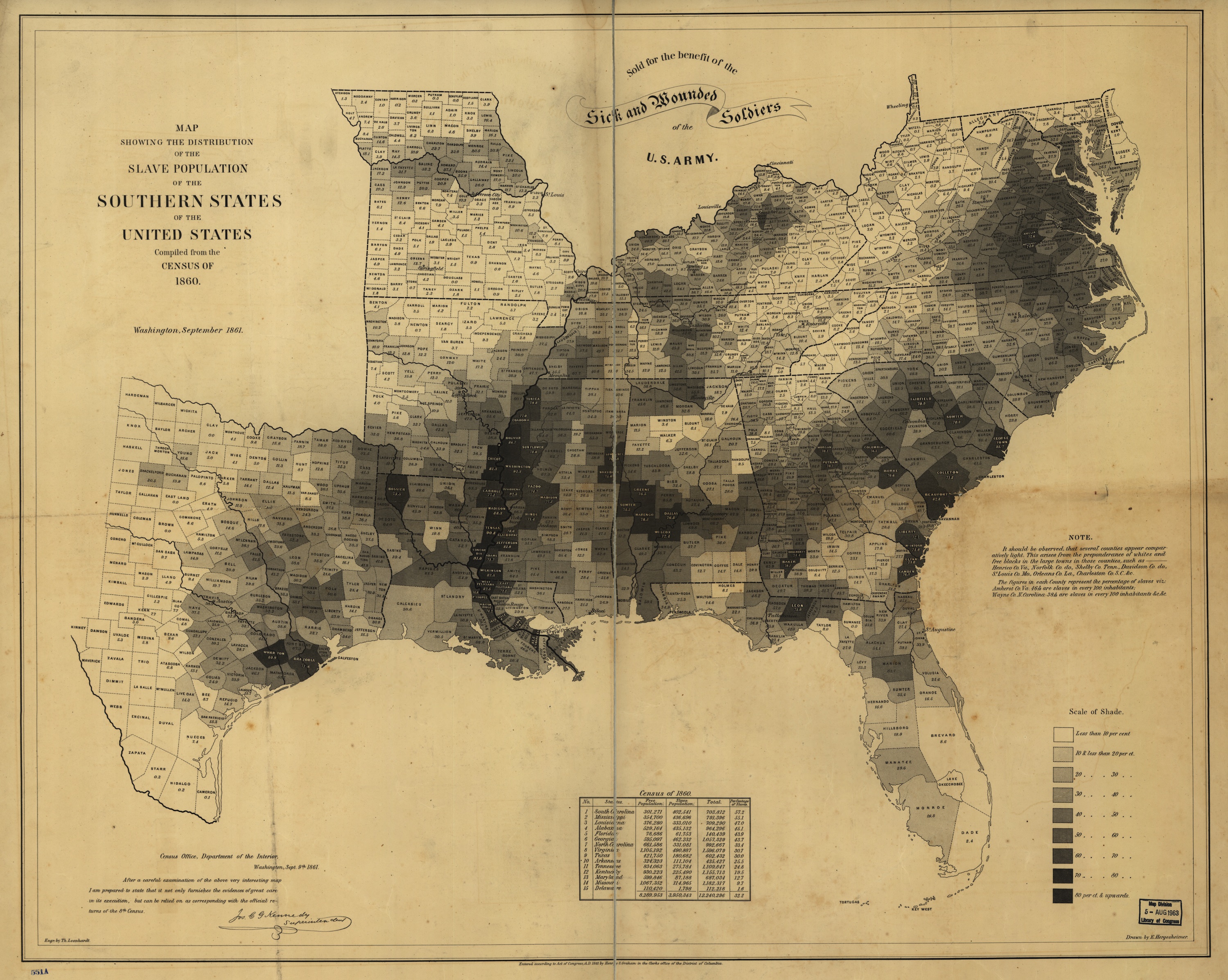
Arrows overlaid on the slavery map mark the general movements of Stoneman's Raid

     We've all seen those color-coded computer-generated maps that give us a county-by-county snapshot of voting results, educational achievement, tornado warnings, or other indicators. It's all based on GIS, which stands for Geographic Information Systems.
     More than a century before GIS was invented, Abraham Lincoln's cartographers explored the concept on this map, which illustrates the prevalence of slavery from Delaware to Texas. Lincoln often referred to the map, and the government sold copies as a fundraiser for sick and wounded soldiers. Francis Bicknell Carpenter even included the slavery map in his historic painting of Lincoln's cabinet (see below).
     The photo above is a closeup of the map, which was drawn by the U.S. Coast Survey in 1861 based on the 1860 census. The darkest counties are those with the highest percentage of slaves in the total population. To see the full map, click here.
     This map illustrates one of the reasons why Stoneman's Raid met relatively light resistance. He was never deep in plantation territory, and few of the Southerners in his path had reason to defend slaveryFor example, slaves were just 17 percent of the population in Knox County, Tenn., 2 percent in Watauga, N.C., 18 percent in Wythe, Va., 27 percent in Rowan, N.C., and 32 percent in Greenville, S.C. 
     Across the Confederacy, slaves represented 39 percent of the population (though they counted as only 24 percent under the "three-fifths compromise" that was so important in pre-war politics).
     By comparison, Sherman marched through parts of Georgia and South Carolina where the majority of the population were slaves. In Beaufort, S.C. (which included what is now Allendale and Jasper), it was 82.5 percent.
     When this map was drawn, West Virginia was still part of Virginia. It was admitted to the Union in 1863 as the 35th state.
     If you look closely, you may notice that many counties were not yet born in 1861, including Avery, Mitchell, Transylvania, Swain, Clay and Graham in the mountains of North Carolina; and Oconee, Cherokee, Greenwood, McCormick, and Saluda in western South Carolina.


The slavery map is visible in the lower right corner of Francis Bicknell Carpenter's 1864 painting, First Reading of the Emancipation Proclamation of President Lincoln. Stoneman's nemesis, Secretary of War Edwin Stanton, is at the far left. Treasury Secretary Salmon P. Chase is standing behind Lincoln. To the right, Interior Secretary Caleb Blood Smith and Postmaster General Montgomery Blair are standing, and Navy Secretary Gideon Wells, Secretary of State William Seward, and Attorney General Edwin Bates are seated. The painting hangs today in the U.S. Capitol, in the West staircase of the Senate wing.

Saturday, August 8, 2015

Scoop! One of Stoneman's newspapers

CREDIT: University of Georgia archives

 When I began researching Stoneman's Raid, I was fascinated to discover that the Union troops published newspapers in three towns they briefly occupied: Salisbury April 12, Spartanburg April 30, and Athens May 6, 1865.
 I contacted historians in all three towns but was unable to find any of these newspapers during the 150th-anniversary run of The Stoneman Gazette. That was disappointing but not surprising. Confederate publishers did not keep Yankee scrapbooks. In fact, they often erased history as they shaped the myth of the Lost Cause. For example, the publisher of the Salisbury newspaper squelched any mention of Stoneman's Raid in a 618-page history of Rowan County that he published 16 years after the war. (Stoneman's scribes did not ignore him, as we shall see!)
 So I was pleasantly surprised to hear recently from a diligent librarian at the University of Georgia who was able to track down this copy of the Athens paper (click here to enlarge the image). Even better, it includes stories from the other two editions.
 You may not be impressed, but this old newspaperman feels like he has found a buried treasure.
 Each story warrants its own discussion, which we will do in subsequent blogs. Follow the links below.
 The scanned copy is smudged and hard to read, but I think this is what it says: